The Strategic Return of Audemars Piguet to Watch Fairs
- 15 mars
- 6 min de lecture
Dernière mise à jour : 1 mai

Does It Signal the Renaissance of Global Horology Events?
In the rarefied world of haute horlogerie, strategic moves are rarely accidental. When a powerhouse like Audemars Piguet decides to return to the global watch-fair circuit after years of deliberate absence, the message resonates far beyond the brand itself. It reverberates through the entire ecosystem of luxury watchmaking from independent artisans in the Vallée de Joux to collectors in New York, Dubai, and Singapore.
That is precisely why the announcement that Audemars Piguet will participate in Watches and Wonders Geneva 2026 has captured the attention of the industry. The manufacture from Le Brassus had largely stepped away from traditional trade shows since 2019, favoring proprietary events and direct engagement with clients. Its return to the world’s most influential horological gathering raises an intriguing question: are we witnessing the rebirth of the watch fair itself?
To understand the significance of this move, one must first understand the changing landscape of luxury watchmaking a sector that has undergone profound transformation over the past decade.

A Brand That Chose Independence
Founded in 1875 in the village of Le Brassus by watchmakers Jules Audemars and Edward Piguet, Audemars Piguet has long cultivated a reputation for independence. Unlike many of its competitors, the brand remains privately owned and controlled by the founding families, an unusual position in an industry dominated by large conglomerates.
This independence has often allowed the brand to chart its own path.
The maison’s reputation was cemented in 1972 with the launch of the Royal Oak, designed by legendary watch designer Gérald Genta. At the time, the Royal Oak was revolutionary a luxury sports watch in steel priced like gold. What initially shocked the market eventually became one of the most recognizable watch designs in history.
Over the decades, the brand built a portfolio of complex timepieces minute repeaters, perpetual calendars, and tourbillons while simultaneously cultivating cultural collaborations with artists, musicians, and athletes.
But despite its heritage, Audemars Piguet has never been afraid to disrupt industry norms.

Why Audemars Piguet Left the Watch Fair Circuit
In 2019, the brand made headlines when it announced it would no longer participate in the traditional salon system, including the historic Salon International de la Haute Horlogerie (SIHH), which later evolved into Watches and Wonders.
Instead, the company adopted a radically different approach.
Rather than unveiling watches once a year in a single event, Audemars Piguet introduced a multi-launch calendar, releasing new models throughout the year. The strategy allowed the brand to maintain constant attention rather than concentrating all publicity in one week.
At the same time, the company invested heavily in immersive brand experiences including the futuristic museum and exhibition complex known as “House of Wonders” in Le Brassus.
For several years, the strategy seemed to work. In a market increasingly driven by digital storytelling and social media visibility, the brand was able to speak directly to collectors without relying on industry intermediaries.
But the watch world continued to evolve.
The Rise of Watches and Wonders
Meanwhile, Watches and Wonders was quietly becoming the central stage of global horology.
Held each spring in Geneva, the event gathers the world’s most prestigious watchmakers including Rolex, Patek Philippe, Vacheron Constantin, and Cartier.
What began as an industry trade fair has evolved into a hybrid event combining professional exhibitions, media presentations, and public access. The format has expanded dramatically in recent years, attracting both collectors and a global audience of watch enthusiasts.
The 2026 edition will feature 66 exhibiting brands, including newcomers and returning names, underscoring the event’s growing influence.
In this context, the return of Audemars Piguet is not simply another exhibitor joining the lineup it represents the return of one of the most influential independent watchmakers in the world.
A Strategic Reconnection With the Industry
From a strategic perspective, the decision reflects a subtle shift in the relationship between brands and the broader watch ecosystem.
Trade fairs still serve several critical functions:
global media visibility
direct engagement with retailers and collectors
industry networking
and, perhaps most importantly, symbolic leadership
When the most prestigious houses gather in the same place, the event becomes a global narrative moment for watchmaking.
By returning to Watches and Wonders, Audemars Piguet reconnects itself with that collective narrative.
Industry analysts see the move less as a reversal and more as a strategic recalibration.
The brand can continue its year-round release strategy while still benefiting from the global attention that the Geneva fair generates.
Celebrating 150 Years of Innovation
Timing also plays a crucial role.
The return comes in the wake of Audemars Piguet’s 150th anniversary, celebrated in 2025 a milestone that highlighted the brand’s historical legacy and technical prowess.
Recent releases have showcased this heritage, including complicated movements and experimental designs that push the boundaries of traditional watchmaking.
Among the notable innovations unveiled recently is the Neo Frame Jumping Hour, a contemporary reinterpretation of a rare complication that displays the hour through a jumping aperture rather than rotating hands.
Such creations reinforce the brand’s position at the intersection of traditional craftsmanship and avant-garde design.




Beyond the Royal Oak
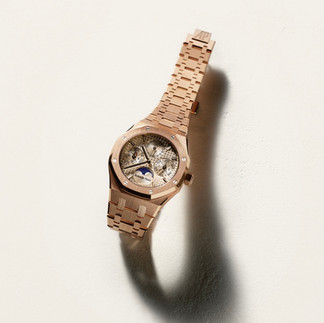
For decades, the Royal Oak has dominated the brand’s image. Its instantly recognizable octagonal bezel and “tapisserie” dial have become symbols of modern luxury.
Yet the company has increasingly sought to broaden its identity beyond this iconic model.
Recent collections such as the Code 11.59 reflect a deliberate effort to explore new aesthetics and technical architectures.
The Geneva stage offers the perfect setting to present this broader vision.
Watch fairs are not only commercial events; they are storytelling platforms. For brands seeking to redefine their narrative, few stages are more powerful.
The Cultural Dimension of Modern Watchmaking
Another reason for the brand’s return lies in the changing cultural role of watchmaking.
Luxury watches today occupy a unique space at the intersection of craftsmanship, investment, and cultural expression. Collectors increasingly treat them as art objects wearable sculptures that combine mechanical ingenuity with design.
Audemars Piguet has long embraced this cultural dimension.
Through its Audemars Piguet Contemporary program, the brand commissions large-scale artworks from international artists, reinforcing its identity as a patron of contemporary art.
Such initiatives resonate strongly in an era when luxury consumers are seeking experiences and cultural meaning rather than mere status symbols.
At Watches and Wonders, where art installations and immersive presentations are increasingly common, this positioning becomes particularly powerful.
The Competitive Landscape
The return also highlights the intensifying competition among elite watchmakers.
In recent years, the luxury watch sector has experienced extraordinary demand, driven in part by a new generation of collectors particularly in Asia, the Middle East, and the United States.
Waiting lists for iconic models have stretched into years. Secondary-market prices for certain references have skyrocketed.
In this environment, visibility and brand storytelling have become critical.
Events like Watches and Wonders function as global stages where brands reaffirm their relevance.
For Audemars Piguet, participating in that conversation ensures that the brand remains central to the evolving narrative of high watchmaking.
The Future of Watch Fairs
The deeper question raised by this development concerns the future of the watch fair itself.
For several years, many observers predicted the decline of such events. Digital communication and direct-to-consumer marketing seemed to render them obsolete.
Yet the opposite may be happening.
As luxury increasingly revolves around experience, the physical gathering of brands, collectors, journalists, and retailers becomes more valuable.
The fair is no longer simply a trade show. It has become a cultural festival of watchmaking.
In that sense, Audemars Piguet’s return may signal a broader renaissance.

A Symbolic Moment for the Industry
Ultimately, the significance of the brand’s decision goes beyond a single exhibition booth.
It reflects a recognition that even the most independent watchmakers benefit from participating in the collective theater of the industry.
For collectors and enthusiasts, the presence of Audemars Piguet at Watches and Wonders restores a certain completeness to the event a sense that the full spectrum of haute horlogerie is once again gathered under one roof.
And in an industry built on heritage, craftsmanship, and storytelling, such symbolism matters.
The return of Audemars Piguet to the world’s most prestigious watch fair may therefore mark more than a strategic marketing move.
It may mark the beginning of a new chapter in the global culture of watchmaking.
HauteHorlogerie
WatchesAndWonders
AudemarsPiguet
LuxuryWatchIndustry
SwissWatchmaking


Commentaires