Nicolas Di Felice Didn’t Revive Courrèges He Reprogrammed How We Experience Clothes
- 12 avr.
- 4 min de lecture

Nicolas Di Felice Didn’t Revive Courrèges He Reprogrammed How We Experience Clothes
The news of his departure travelled fast.
In the space of a few hours, headlines formed, analyses began, and the familiar cycle of speculation took over. Who next. What now. Where will he go.
But none of these questions capture what truly matters.
Because what Nicolas Di Felice leaves behind at Courrèges is not just a body of work.
It is a shift in perception.
When he arrived in 2020, the narrative was already written for him. Courrèges was a heritage house in need of revival. Its legacy was clear. Space Age optimism, clean lines, a vision rooted in the future as imagined in the past.
The expectation was restoration.
What he delivered was something else entirely.
He did not attempt to recreate the future as it once was. He asked a different question. What does the present feel like, right now, inside the body?
That question became the foundation of his work.
From the beginning, his collections resisted easy categorization. They were often described as minimal, but that word never fully applied. Minimalism suggests absence. Reduction. Silence.
Di Felice’s work was never silent.
It was tense.
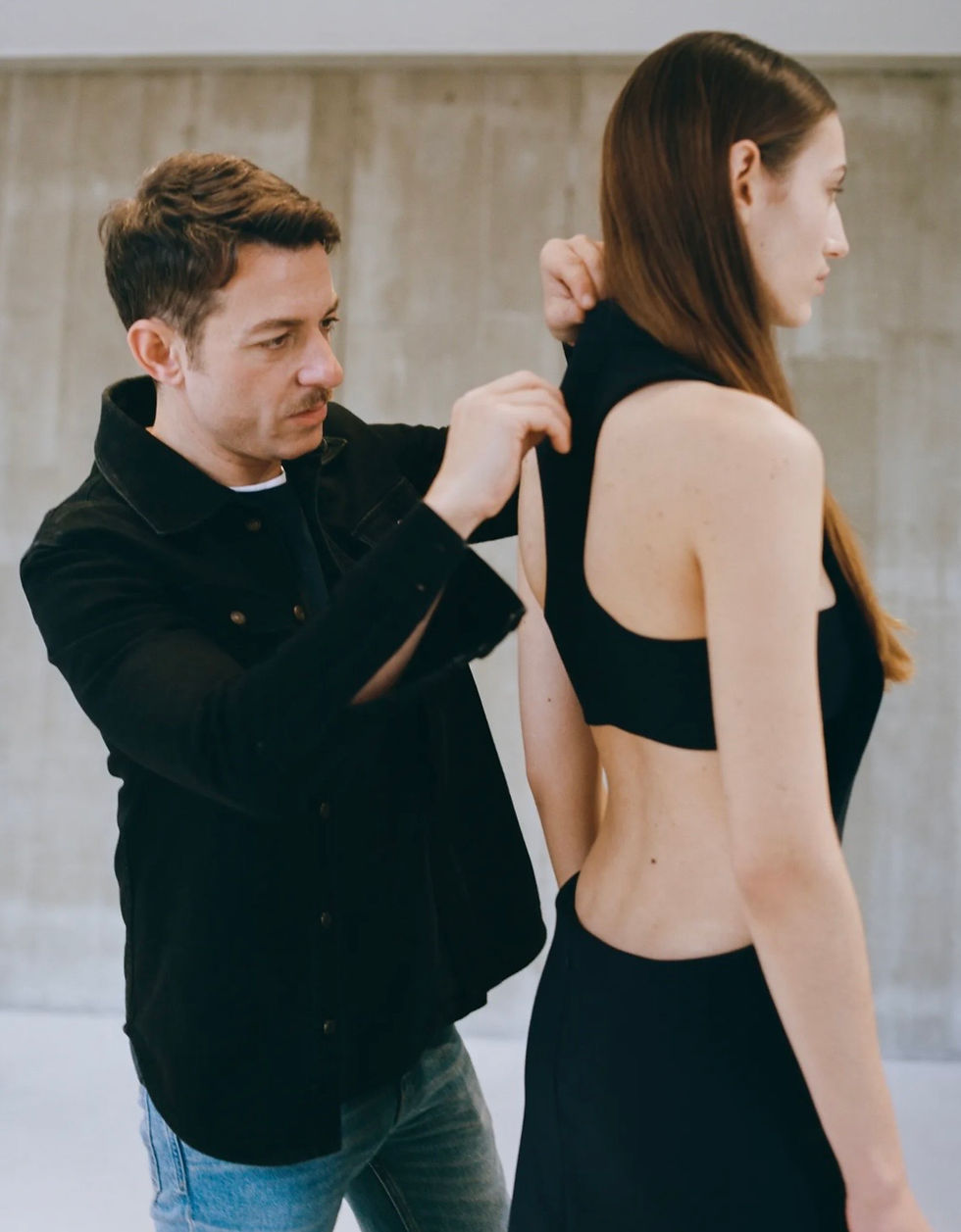
There was always something happening beneath the surface. A pull between exposure and control. Garments that revealed the body, but never surrendered to it. Cuts that traced movement rather than shape. Materials that held structure while suggesting fluidity.
According to show analyses published by Vogue, this tension became one of the defining characteristics of his tenure. Not an aesthetic signature in the traditional sense, but a sensory one.
His clothes were not just seen.
They were experienced.
This distinction is essential.
In an industry historically driven by image, Di Felice shifted the focus toward sensation. His runway shows reflected this approach. They were constructed less as presentations and more as environments.
One collection unfolded to the sound of a ticking clock. Another followed the rhythm of a day moving through the city. Models did not simply walk. They moved with intention, as if embedded in a timeline.
Time itself became part of the garment.
This idea extended into the materials.
One of his most discussed collections incorporated metro tickets into the construction of pieces. At first glance, the gesture could be read as conceptual. But within his broader framework, it made perfect sense.
The metro is movement. Repetition. Urban rhythm.
By embedding it into clothing, he collapsed the distance between environment and body.
This is where his work becomes particularly relevant today.
Contemporary fashion is saturated with references. Archives, nostalgia, reinterpretation. Many designers look backward to move forward.
Di Felice looked sideways.
He observed the present. The way bodies move through space. The way clothing interacts with daily life. The tension between exposure in the digital world and protection in the physical one.
His garments reflect that tension.
They are precise, but never rigid. Sensual, but never excessive. Structured, but always aware of movement.
Industry commentary from Business of Fashion has noted the growing importance of emotional engagement in fashion. Consumers are no longer responding only to visual impact. They are seeking connection. Feeling. Meaning.
Di Felice anticipated this shift.
He designed for it.
This is why his work resonated so strongly with a younger audience. Not because it was trend driven, but because it felt aligned with their lived experience. Fast moving, visually aware, physically conscious.
Clothing, in his hands, became a tool for navigating that experience.
And this is where the real transformation of Courrèges took place.
The brand did not simply become desirable again. It became relevant in a different way. It moved from heritage to immediacy. From archive to presence.
The now well documented “Courrèges club” concept illustrates this perfectly.
It was not just a marketing initiative. It was an extension of his vision. A space where the clothes existed in context. Where sound, movement, and bodies interacted.
Fashion was no longer isolated.
It was integrated.
This integration is perhaps his most important contribution.
He blurred the boundary between garment and environment. Between design and experience. Between object and moment.
And in doing so, he redefined what a collection could be.
From a business perspective, this approach proved effective. The brand gained visibility, cultural relevance, and a renewed position within the contemporary landscape.
But its true value lies elsewhere.
It changed how we read clothes.
Traditionally, fashion is decoded through visual cues. Silhouette, color, reference. Di Felice introduced another layer.
Feeling.
Not in an abstract sense, but in a tangible one. How a garment holds the body. How it moves. How it creates awareness.
This shift may seem subtle, but its implications are significant.
It suggests a future where fashion is not only seen, but lived more consciously. Where design is measured not just by appearance, but by its ability to engage the senses.
This is not an easy language to replicate.
Which brings us back to his departure.
Replacing a creative director often involves continuity or disruption. Maintaining direction or initiating change.
In this case, the challenge is more complex.
Because what Di Felice created is not just a direction.
It is a system of perception.
A way of thinking about clothing that extends beyond aesthetic codes.
Whoever comes next will inherit more than a brand.
They will inherit a sensitivity.
Whether they choose to preserve it, reinterpret it, or move away from it entirely will define the next chapter of Courrèges.
But one thing is certain.
The conversation has shifted.
We are no longer asking only what fashion looks like.
We are beginning to ask what it feels like.
And that question may be his most lasting legacy.
FashionDepth
CreativeIntelligence
Courreges
DesignPhilosophy
LuxeMagazineSwitzerland



Commentaires