Audemars Piguet Takes the Royal Oak Into High Jewellery
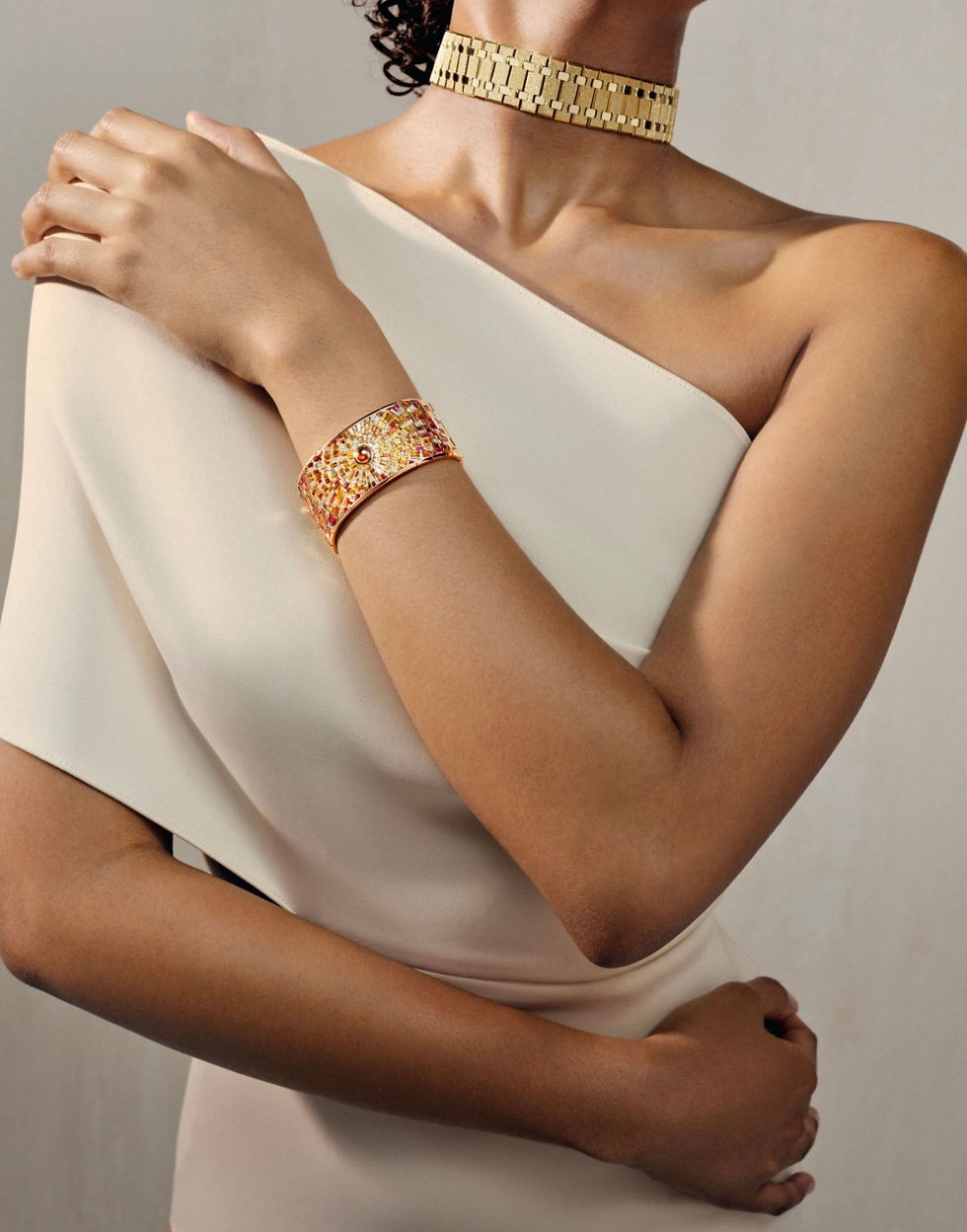
The Swiss watchmaker is extending its most recognisable design language beyond the timepiece with Royal Oak Joaillerie, a 19-piece collection inspired by the geometry of the iconic watch and the landscapes of the Vallée de Joux.
For more than five decades, the Royal Oak has existed at the intersection of watchmaking, design and jewellery. Now, Audemars Piguet is taking that relationship one step further.

© 2026 Audemars Piguet
On October 2, 2026, the Le Brassus manufacture unveiled Royal Oak Joaillerie, its first standalone jewellery collection built around the codes of its most famous creation. Comprising 19 pieces in gold, titanium and precious stones, the collection translates the architecture of the Royal Oak into cuffs, necklaces and earrings without the watch itself.
The move is significant not simply because a major Swiss watchmaker is entering high jewellery, but because Audemars Piguet has chosen not to invent an entirely new visual language. Instead, it is taking the Royal Oak’s geometry apart and reconstructing it as jewellery.


© 2026 Audemars Piguet
From icon to object of adornment
Designed by Gérald Genta and introduced in 1972, the Royal Oak broke with conventional ideas of luxury watchmaking through its octagonal bezel, exposed hexagonal screws, integrated bracelet and hand-finished steel construction. Four years later, Jacqueline Dimier created the first women’s Royal Oak, establishing a parallel history for the model.
That jewellery connection is therefore older than the current launch.
Audemars Piguet traces its relationship with jewellery back to the late 19th century, when the manufacture worked with houses including Tiffany & Co., Cartier, Oscar Heyman and Bulgari on gem-set watches. The company also developed its own jewellery workshop in the 1980s, followed by creations such as the Baroque cuff watch, Millenary Précieuse and Haute Joaillerie pieces.
The new collection is consequently presented by the manufacture less as a departure than as an extension of an existing savoir-faire.
“We continue to explore this creative realm alongside our core watchmaking activity,” Audemars Piguet CEO Ilaria Resta says of the collection, describing jewellery as a way to revisit the brand’s codes and expand its approach to creation.
Three interpretations of the Vallée de Joux
The collection is divided into three distinct expressions: Dream of Joux, Risoud Eclipse and Frosted Gold.
Dream of Joux is the most colourful interpretation. Its gem-setting evokes the landscapes surrounding the manufacture in the Swiss Jura, with references to frozen lakes, night skies and floral forms. Diamonds are combined with sapphires, spessartites, tourmalines, amethysts, tsavorites and topaz across cuffs, necklaces and earrings.
Risoud Eclipse takes a darker direction. Blackened or PVD-treated titanium is paired with diamonds and sugarloaf emeralds, drawing its visual inspiration from the Risoud Forest and the phenomenon of an eclipse. One necklace, for example, combines five sugarloaf emeralds with brilliant-cut diamonds.
Then there is Frosted Gold, perhaps the clearest bridge between Audemars Piguet’s watchmaking and jewellery vocabulary. Developed with jewellery designer Carolina Bucci, the finish was inspired by an ancient Florentine technique and creates a textured surface resembling a subtle layer of diamond dust. Bucci had previously collaborated with the manufacture on the Royal Oak for women.
© 2026 Audemars Piguet
A jewellery strategy rather than a simple extension
The timing is also noteworthy. According to the Financial Times, Audemars Piguet presented the collection during Paris Fashion Week and is positioning jewellery as a way to broaden its relationship with female clients. The publication reports that prices range from CHF 48,000 to several million dollars, with the collection initially being presented through private events rather than a conventional retail rollout. But the company’s stated ambition goes beyond simply adding another revenue category.
In an interview with Luxury Tribune, Resta described the project as a means of amplifying Audemars Piguet’s craftsmanship, particularly expertise in gem-setting, engraving, lapidary work and gemmology.
That distinction matters. The Royal Oak Joaillerie pieces are not miniature watches without movements. They are an exercise in translating the physical language of the Royal Oak its articulated links, proportions, surfaces and relationship with light into another category.
The result is a collection that asks a deceptively simple question: what happens when the bracelet of one of the world’s most recognisable watches becomes the jewel itself? For Audemars Piguet, the answer is Royal Oak Joaillerie a new chapter in which the watch remains absent, but its DNA is unmistakable.
Patricia Holdener
Editor-In-Chief
Luxe Magazine Switzerland
AudemarsPiguet RoyalOak
RoyalOakJoaillerie HighJewellery
FineJewellery SwissLuxury
LuxuryWatches ValléeDeJoux Jewellery
HauteJoaillerie CarolinaBucci LuxuryNews
LuxeMagazineSwitzerland



Commentaires