Cartier’s Wild Side: Inside the Maison’s Extraordinary World of High Jewellery Animals

From sculptural tigers and crocodiles to the iconic Panthère de Cartier, the French Maison transforms the animal kingdom into an extraordinary expression of colour, craftsmanship and untamed elegance. Featuring Scottish actress Tilda Swinton, Cartier’s latest jewellery creations celebrate a century-long fascination with wildlife, precious materials and the art of bringing nature to life.
Wild by Nature: Cartier’s Enduring Fascination with the Animal Kingdom
At Cartier, the animal kingdom has never been merely a source of inspiration. It is a living part of the Maison’s creative identity, a universe shaped by history, imagination and an enduring fascination with the natural world.

Rings with tiger, parrot, carp, crocodile or rhinoceros heads, this jewellery collection expresses itself with a great blow of the jaw, beak or muzzle. This powerful approach echoes in particular through the Panther’s head ring, created in the 2000s.
Since the beginning of the twentieth century, Cartier’s jewellery fauna has occupied a privileged place in its artistic heritage. Birds appeared first, followed by insects, reptiles, felines and mythical chimeras. The zebra and the elephant subsequently expanded this extraordinary bestiary, creating a world populated by creatures that embody strength, mystery and individuality.
At the heart of this universe reigns the emblematic Panthère de Cartier. First appearing in three-dimensional sculptural form in 1948, the Panther has become one of the Maison’s most recognisable symbols, embodying independence, sensuality and untamed power.


FROM ONE HEAD TO ANOTHER,
CARTIER CULTIVATES THE ART OF COLOUR
CONTRASTS
Her indomitable spirit continues to inspire Cartier’s living, ferocious and familiar creatures, whose expressive possibilities are explored through the Maison’s latest jewellery collections. These creations perpetuate a distinctive heritage while celebrating the remarkable diversity of species that inhabit Cartier’s imaginative animal kingdom.
From the tiger and parrot to the carp, crocodile and rhinoceros, each creature becomes the subject of a sculptural portrait in precious materials. Together, they form a gallery of extraordinary jewels in which creativity, technical mastery and an instinctive understanding of nature converge. From the Arctic to the tropics, from the depths of the sea to arid landscapes, Cartier observes the animal world with remarkable attention to anatomy, texture and movement. Translating these observations into jewellery requires the combined expertise of designers, jewellers, lapidaries, gem-setters and watchmakers, all united by a shared pursuit of artistic excellence.
Through their hands, precious materials are shaped, sculpted and polished until the creations seem to acquire a life of their own. Some embrace the skin with the fluidity of a living creature, like the Panther curled into an intimate tête-à-tête embrace, its white-gold form entirely covered in diamonds. Others transcend conventional jewellery design, transforming an animal into a sculptural presence on the dial of a watch.


CREATED IN CARTIER’S
JEWELLERY WORKSHOPS
Every creature possesses its own distinctive character and independent spirit. In Cartier’s universe, these qualities become an extension of the personality of the person who wears the jewel.
The Gallery of Animal Portraits: Five Creatures, Five Distinctive Personalities
Scottish actress Tilda Swinton, Cartier’s new ambassador, brings her singular artistic presence to a creative project celebrating the Maison’s wildlife-inspired jewellery. Renowned for her versatility and distinctive screen presence, the multi-award-winning actress embraces a collection built around five magnetic creatures, each expressing its own character and symbolic power.
The tiger, parrot, carp, crocodile and rhinoceros emerge through sculptural rings featuring powerful animal heads. Their jaws, beaks and muzzles become defining elements, giving each jewel a striking physical presence.


THE EXPERTISE
OF THE LAPIDARY
This approach echoes the Panther-head ring created in the 2000s, extending a design language in which animal portraiture becomes both an artistic statement and a personal emblem.
Each stylised head presents formidable technical challenges. Cartier’s designers, jewellers, lapidaries and gem-setters work together to capture the distinctive anatomy of each species while preserving the expressive force of the original inspiration.
Spectacular volumes, carefully articulated contours and intricate surface treatments give the animals a sense of presence on the hand. Rather than simply reproducing their appearance, Cartier distils their most recognisable features into sculptural forms that balance naturalism with artistic abstraction.
The result is jewellery that conveys character at a glance, transforming the animal kingdom into a collection of powerful, wearable portraits.

HE CROCODILE
BRACELET AND
NECKLACE
Cartier’s Art of Colour: Contrasts Inspired by the Natural World
Colour plays a central role in defining the personality of each animal. Drawing on one of the Maison’s great historical traditions, Cartier combines contrasting gemstones and materials to recreate the distinctive visual language of its creatures.
The parrot is expressed through vibrant red and green tones, pairing coral with tsavorite garnets. The rhinoceros takes on a warmer, more subdued palette of orange and opaline hues, created through spessartite garnets and smoky quartz.
For the crocodile, white, black and green establish a striking visual identity. Diamonds illuminate the surface, onyx spikes evoke the animal’s distinctive crest, and emeralds introduce flashes of intense green.

HE TIGER
BRACELET AND
NECKLACE
Shades of blue define other creations, including the tiger and carp, through combinations of sapphires, aquamarine and dumortierite quartz. These carefully considered contrasts do more than reproduce the colours of the natural world. They create depth, reinforce the sculptural character of each jewel and establish a dialogue between gemstones, precious metals and the forms they represent.
Through this chromatic approach, Cartier transforms the characteristics of each species into a distinctive design signature, allowing every animal to retain its own identity within the wider collection.

THE PANTHÈRE
DE CARTIER
SET


AN AESTHETIC
THAT REQUIRED
THE INTERVENTION
IN UNISON OF THREE
PROFESSIONS.
Inside Cartier’s Jewellery Workshops: The Art of Bringing Animals to Life
Behind the expressive appearance of Cartier’s animal jewellery lies a succession of highly specialised techniques, developed through generations of craftsmanship.
Created in the Maison’s jewellery workshops, each piece draws on a long tradition of animal-inspired design. From the initial sculptural concept to the final gemstone setting, every stage requires precision, experience and a close understanding of the materials involved.


The Jeweller’s Art: Sculpting Precious Metals
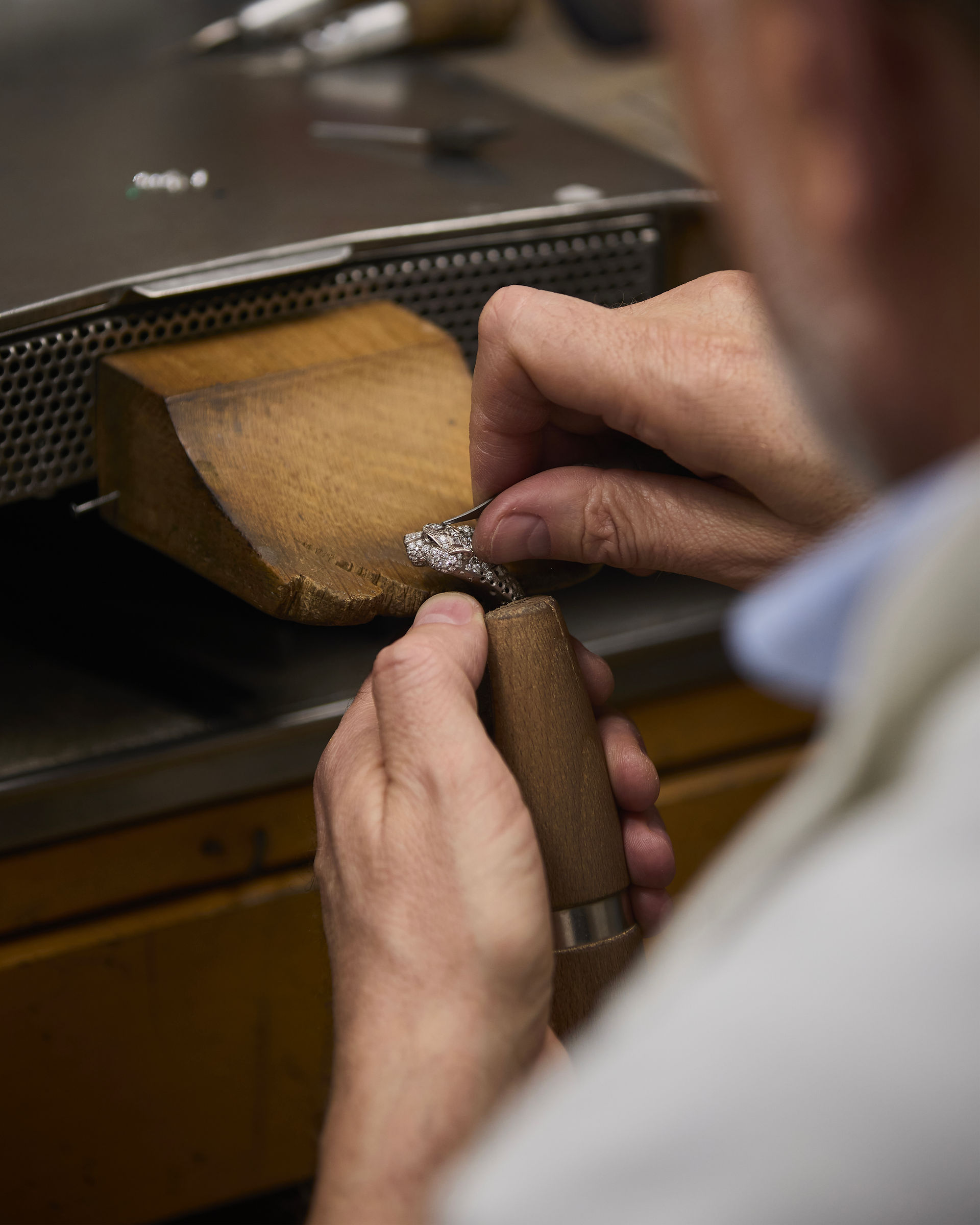
The jeweller plays a central role in translating the original design into a three-dimensional object. Each animal head is carefully chiselled and shaped to capture its defining features, from the contours of the muzzle to the intricate details of its surface.
The parrot combines platinum and yellow gold, bringing different metal tones into a single sculptural composition. The rhinoceros, meanwhile, features alternating surfaces of white gold, some polished and others brushed by hand, to evoke the nuances of the animal’s natural colouring.
These variations in finish create subtle contrasts between light and shadow, enhancing the volume of the forms and reinforcing their visual realism.

Gem-Setting Techniques: Fur, Scales and Frozen Light
Pavé setting, one of Cartier’s signature techniques, plays a crucial role in creating the illusion of animal texture.
Specialised settings evoke the tiger’s fur, the crocodile’s scales and the distinctive contours of the carp’s lips. Calibrated sapphires set in rails introduce a precise, graphic quality, while variations in the size and arrangement of diamonds create depth and movement.
On the tiger ring, a galuchat-effect pavé of white diamonds interspersed with sapphires produces a surface reminiscent of ice and crystallisation. The treatment becomes a jewellery interpretation of the natural world, translating an animal’s appearance into a sophisticated arrangement of light, texture and colour.
These intricate techniques demonstrate how Cartier’s artisans use gemstones not only for their brilliance but also as a means of reproducing the tactile qualities of nature.

The Lapidary’s Expertise: Carving the Details of the Animal Kingdom
The lapidary’s work adds another dimension to Cartier’s sculptural creations, transforming individual gemstones into precise anatomical details.
The rhinoceros’s horns are carved from opalescent smoky quartz and highlighted with a line of black lacquer. The carp’s gills are sculpted in dumortierite quartz, while the parrot’s coral and onyx feather tuft is assembled and adjusted entirely by hand.
For the tiger, dumortierite quartz is carved to create the distinctive stripes that define its appearance.
These details extend beyond visual decoration. Every finish contributes to the physical presence and tactile character of the jewellery, allowing the creatures to convey their identity through both appearance and construction.
The crocodile’s articulated jaw allows its mouth to open, introducing movement into the sculptural design. Alternating white and rose gold suggests the striated palate of the carp, while perforations inside the rhinoceros’s mouth echo the cracked appearance of its skin.
Through this combination of carving, articulation and material contrast, Cartier’s artisans bring an extraordinary level of detail to each animal portrait.
Two Sensory Creations: The Crocodile and Tiger Bracelets and Necklaces
Among the collection’s most technically accomplished creations are the crocodile and tiger jewellery sets, comprising bracelets and necklaces that explore the relationship between realistic animal heads and abstract, flexible bodies.
In both designs, the head is modelled with close attention to the animal’s anatomy, while the body adopts a more graphic and stylised language. This contrast allows Cartier to balance sculptural realism with fluidity, creating jewels that move naturally with the wearer.
The challenge lies in ensuring that every component works as part of a unified whole. The animal must retain its expressive character, while the articulated structure remains comfortable, flexible and responsive to movement.
These creations demonstrate how Cartier’s traditional savoir-faire can be used to explore the sensory possibilities of high jewellery, transforming precious materials into forms that feel almost alive against the skin.
The Cartier Crocodile Bracelet and Necklace: A Study in Fluidity and Contrast
The crocodile jewellery set is defined by a palette of white, green and black, three colours that form part of Cartier’s chromatic heritage and intensify the contrast between the animal’s different features.
At the centre of the design, the sculptural crocodile head functions as the clasp. Integrated into the mouth of the animal, the mechanism allows the crocodile to appear to bite the back of the bracelet. Developing this ingenious system required specific technical work to ensure that the clasp remained fully integrated into the design.
The head is covered in sculptural scales represented by geometric diamond settings, contrasted with onyx spikes that evoke the crocodile’s characteristic crest.
The bracelet’s body takes a different approach, prioritising rhythm and fluid movement through a fully articulated structure. Diamonds set using an inverted setting technique form a continuous wave of light, punctuated by onyx elements.
Chrysoprase and rubellites finish the edges of the cuff, introducing additional colour and reinforcing the contrast between the articulated body and the sharply defined animal head.
The result is a creation that combines a powerful sculptural focal point with the flexibility of a piece designed to move naturally on the wrist.
The Cartier Tiger Bracelet and Necklace: Sculptural Power in Shades of Blue
The tiger jewellery set explores a cooler palette, using shades of blue to express the animal’s distinctive markings and intense gaze.
Dumortierite quartz creates the stripes, while sapphire pavé covers the head and body. Aquamarine eyes provide a luminous focal point, bringing the sculptural face into sharp relief.
Cartier further emphasises the tiger’s character through a graphic galuchat-effect diamond setting on the head. The textured surface introduces a subtle contrast with the brilliance of the gemstones, reinforcing the relationship between material, light and animal anatomy.
As with the crocodile design, the opening and closing mechanism is concealed within the animal’s mouth. Its development required specific engineering to integrate the clasp without interrupting the bracelet’s visual continuity.
The tiger bracelet’s body contrasts with the realism of its head. An abstract pattern of dumortierite quartz and sapphires rests on a fully articulated gold structure composed of movable links.
Chalcedony beads, each punctuated by a sapphire in an inverted setting, add another dimension to the composition. Their arrangement enhances the interplay of materials and movement, allowing the bracelet to respond fluidly to the wearer.
Together, the tiger bracelet and necklace capture the balance between controlled geometry and untamed character that defines Cartier’s animal-inspired creations.
The Panthère de Cartier Set: The White Diamond Panther
At the heart of Cartier’s animal universe, the Panthère remains an enduring symbol of independence, elegance and power.
The new interpretation of the emblematic Panthère tête-à-tête bracelet explores the Panther through an immaculate white palette. Its sculptural form is entirely pavé-set with geometric diamonds, creating the impression of a luminous coat marked by the subtle rhythm of contrasting textures. The design alternates galuchat-effect pavé in different diamond sizes with caviar pavé, creating a sophisticated interplay of light across the stone-covered surfaces and the white-gold structure.
Crafted in the great tradition of Cartier’s animal savoir-faire, this snow-white Panther features two emerald eyes surrounded by a fur setting that evokes the animal’s coat.
The combination of diamonds, emeralds and intricate setting techniques transforms the familiar Panther motif into a striking study of monochromatic brilliance. Its sculptural presence reinforces the Maison’s longstanding fascination with the animal that has become one of its most recognisable signatures.

The Panthère de Cartier Jewellery Watch: A Sculptural Guardian of Time
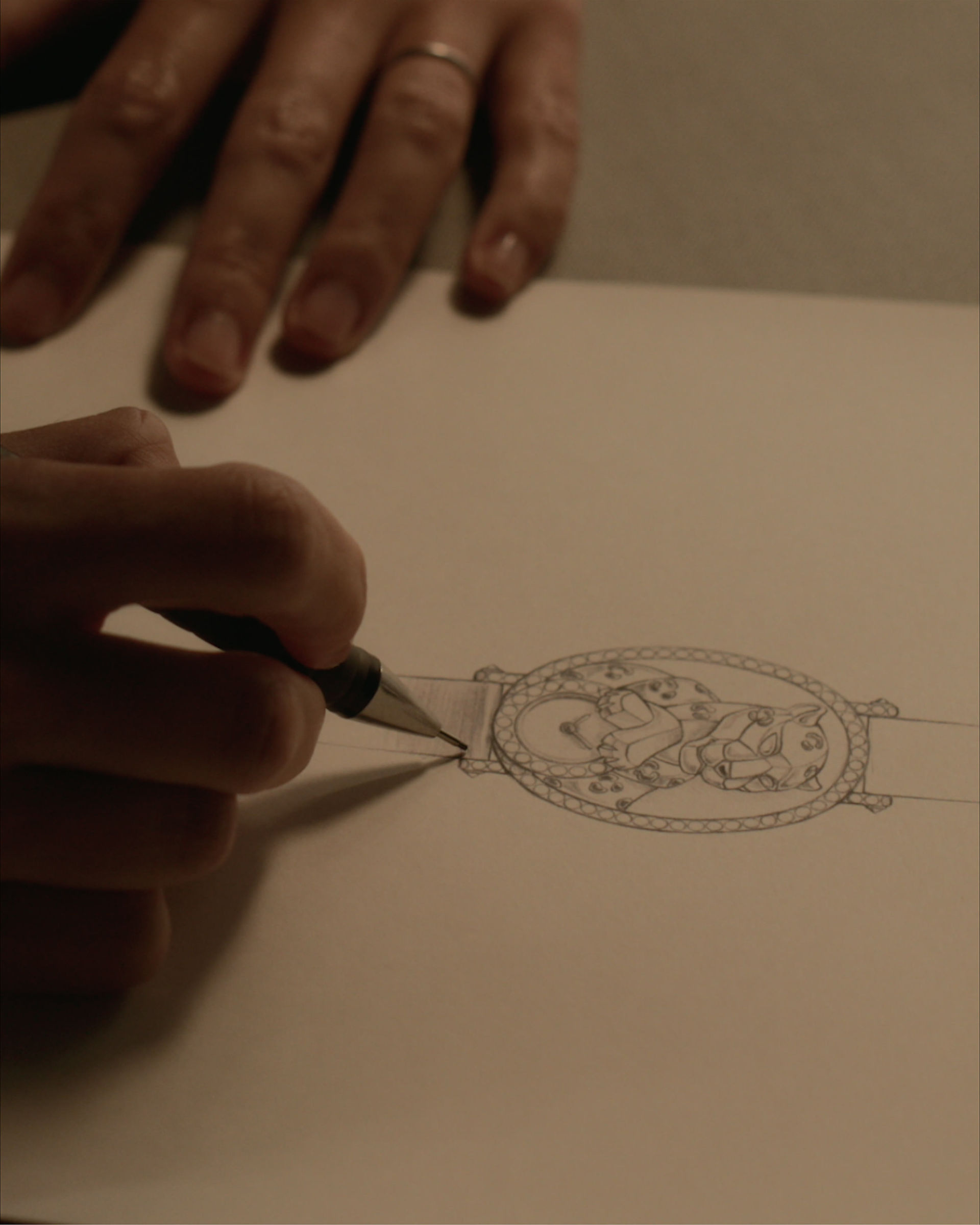
Cartier’s fascination with the animal kingdom extends beyond jewellery into the world of fine watchmaking, where sculptural forms and rare decorative techniques come together. Created by Cartier’s Maison des Métiers d’Art in La Chaux-de-Fonds, Switzerland, the medallion-shaped Panthère jewellery watch draws inspiration from the ancestral art of cameos. The Maison des Métiers d’Art is dedicated to preserving and developing rare crafts, including enamelling and marquetry. The watch brings together three distinct areas of expertise, each contributing to the Panther’s expressive presence.
Design: A Panther Beyond the Dial
The designer imagines the Panther as a graphic, expressive sculpture, its magnetic presence suggesting a guardian of time.
Rather than treating the animal as a decorative addition to the watch, the composition gives it a central role, transforming the timepiece into a sculptural portrait that combines artistic expression with horological function.
Gem-Setting: Light Through Precious Stones
The gem-setter enhances the brilliance of the composition by replacing metal surfaces with precious stones wherever possible.
Onyx defines the nose and dial, while tsavorite garnets form the eyes. Diamonds illuminate the four lugs of the case and its bezel, creating a luminous frame around the sculptural Panther.
The careful placement of each stone contributes to the depth and visual intensity of the design, demonstrating how gem-setting can become an integral part of the artistic expression.
Lacquer: The Final Signature of the Panther
The lacquerer’s expertise brings the Panther’s stylised spots to life, drawing inspiration from Cartier’s vintage creations.
This final decorative stage adds definition and character to the sculpture, completing the dialogue between precious materials, surface treatments and the Maison’s historical design language.
The result is a jewellery watch in which the Panther becomes more than a motif: it emerges as a sculptural presence, uniting the worlds of fine jewellery, decorative arts and watchmaking.
Pierre Rainero on Cartier’s Distinctive Animal Aesthetic
For Pierre Rainero, Cartier’s Director of Image, Style and Heritage, the Maison’s animal universe is defined by the individuality of its creatures and the freedom of its artistic interpretation.
“The Cartier fauna is distinguished by its character. First of all, in the choice of species – big cats, reptiles, savannah animals… and also in the creative treatment, between naturalism and extreme stylisation. Through the interplay of design, materials, and execution, Cartier questions the very perception of the animal and opens up extraordinary possibilities for exploring forms.
“Each creature, each creation reveals its own symbolic force, reflects an attitude, a personality trait or a state of mind. It becomes an opportunity to deliver a message about yourself.”
His words capture the essence of Cartier’s approach to animal-inspired jewellery. The Maison does not simply seek to imitate the natural world; it interprets its forms, distils their defining characteristics and transforms them into objects that communicate individuality.
Cartier’s Animal Kingdom: Where Nature Meets High Jewellery
From the sculptural Panther to the richly coloured parrot, the powerful crocodile, the striped tiger, the distinctive rhinoceros and the delicately detailed carp, Cartier’s animal creations reveal the extraordinary breadth of the Maison’s artistic imagination.
Each piece reflects a meeting of observation, design and technical mastery. Gemstones become feathers, scales and fur; precious metals acquire the contours of living creatures; and intricate mechanisms introduce movement into sculptural forms.
The result is a jewellery universe that moves between naturalism and abstraction, drawing on the diversity of wildlife while remaining unmistakably Cartier. Through generations of craftsmanship and a constant exploration of materials, the Maison continues to transform the animal kingdom into a language of personal expression. These creatures are not simply admired for their beauty or power. They become symbols of character, freedom and individuality, carrying their own distinctive spirit wherever they are worn.
Patricia Holdener
Editor In Chief
Luxe Magazine Switzerland
Cartier WildByNature PanthereDeCartier
CartierHighJewellery AnimalJewellery
HighJewellery LuxuryJewellery FineJewellery
TildaSwinton CartierSavoirFaire
LuxuryWatches
JewelleryCraftsmanship
LuxeMagazineSwitzerland


Commentaires