The Cartier Cheich: From Dakar’s Desert to a $3.4 Million Auction Record

There are watches that are designed to tell time, and there are watches that seem to carry an entire era inside their case. The Cartier Cheich belongs to the second category.
On September 18, 2026, at Sotheby’s Hong Kong, a unique white-gold Cartier Cheich sold for HK$26.52 million, including fees approximately US$3.4 million. The result established a new auction record for a Cartier wristwatch, according to Sotheby’s and multiple specialist watch publications. The bidding lasted nine minutes, with collectors participating in the room, by telephone and online.
But the price is only the final chapter.
To understand why this unusually shaped watch commanded such a figure, it is necessary to go back to the Sahara, to the extraordinary mythology of the Paris-Dakar Rally, and to an idea that Cartier conceived in the early 1980s.
In 1983, Cartier joined forces with Paris-Dakar founder Thierry Sabine to create the Cartier Challenge. The rule was brutally simple: win the same category of the rally two years in succession, and the winner would receive something far more unusual than a conventional trophy a Cartier watch inspired by the desert headscarf known as the cheich.
The design transformed the symbolism of the rally into an object. Rather than placing a racing emblem on a conventional watch, Cartier turned the entire case into the emblem itself. The sculptural folds of the head covering became the architecture of the wristwatch.


Only one competitor ultimately achieved the feat.
Belgian motorcycle champion Gaston Rahier won the Paris-Dakar motorcycle category in 1984 and again in 1985. His reward was the Cartier Cheich, a piece that had never been offered for sale through Cartier boutiques and was created specifically as a trophy. Sotheby’s later sold Rahier’s watch in Paris in 2022 for more than €1 million, bringing a forgotten chapter of Cartier’s history back into the spotlight.
Then came an unexpected sequel.
More than two decades after the original Cartier Challenge had disappeared into history, Cartier recreated the Cheich not for another rally winner, but for collector Giorgio Seragnoli. In 2010, the maison produced a unique white-gold example, numbered No. 1 of 1. Sotheby’s describes Seragnoli as the co-author of Cartier Bianco and the owner of an exceptionally important collection of white-metal Cartier watches.
Technically, the watch is almost understated compared with its auction price. It measures approximately 38 by 27 millimetres, is made from 18-karat white gold and uses a jewelled quartz movement. The dial is white, while the case back is secured by four screws. It comes on a brown Cartier leather strap with a white-gold folding clasp.
That quartz movement is part of what makes the result so intriguing.
The auction market often places enormous emphasis on mechanical complexity. Yet here, a quartz Cartier a movement type rarely associated with seven-figure collector trophies reached HK$26.52 million. SJX Watches reported that the result also represented a record for a quartz wristwatch.
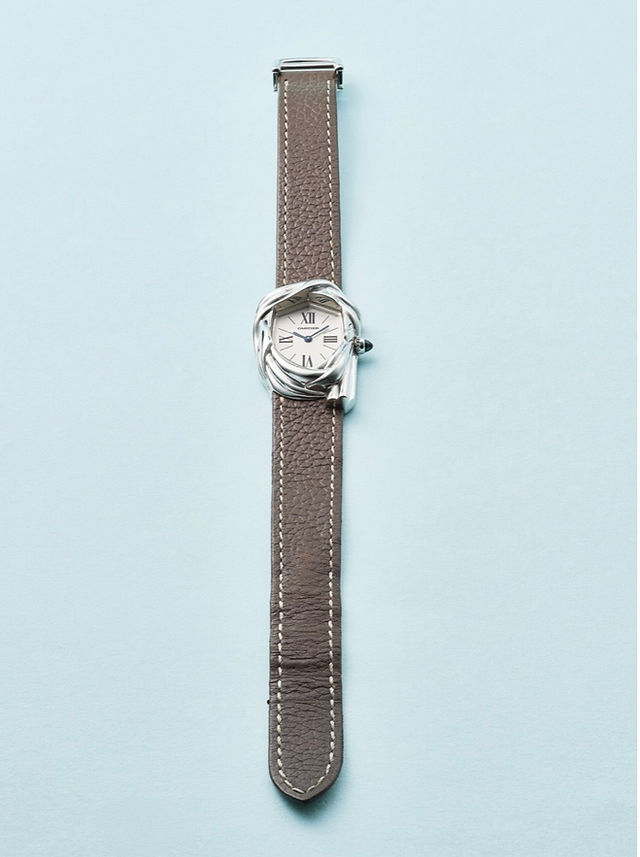

The Cheich therefore tells a broader story about contemporary collecting. Its value is not built around complications or production numbers alone. It comes from the convergence of design, provenance, mythology and absolute rarity.
There are only five known Cheich watches today: four connected to the original Cartier Challenge era, plus the unique white-gold commission created in 2010. One of the original pieces remains missing, while others are associated with Cartier’s collection.
That makes the Hong Kong sale more than another auction headline. It is a reminder that, at the highest level of collecting, the most valuable objects are sometimes those that were never intended to become commodities at all.
The Cheich began as a promise in the desert: achieve the impossible, and Cartier would create something worthy of the achievement.

Four decades later, that philosophy has produced an entirely different kind of victory one measured not in kilometres across the Sahara, but in millions at auction.
Patricia Holdener
Editor-In-Chief
Luxe Magazine Switzerland
Cartier CartierCheich SothebysHongKong
LuxuryWatches
RareWatches
WatchAuction HauteHorlogerie ParisDakar
WatchCollectors LUXEMagazineSwitzerland


Commentaires