CAN LUXURY WATCHMAKING STILL AFFORD TO BE INACCESSIBLE?

Geneva Watch Days exposes the industry’s new equation: heritage, innovation, price and the next generation of collectors
For decades, Swiss luxury watchmaking has operated on a powerful contradiction: the less accessible the object, the greater its desirability.
Scarcity created prestige. Complexity justified price. Heritage established authority. And the distance between the consumer and the manufacture became part of the mythology.
That model is now being tested.
A new analysis published by Business of Fashion on September 7 reports that luxury watchmakers increasingly recognise the need for larger, bolder ideas to attract younger consumers, particularly Generation Z, as the industry reaches the limits of its established strategy.
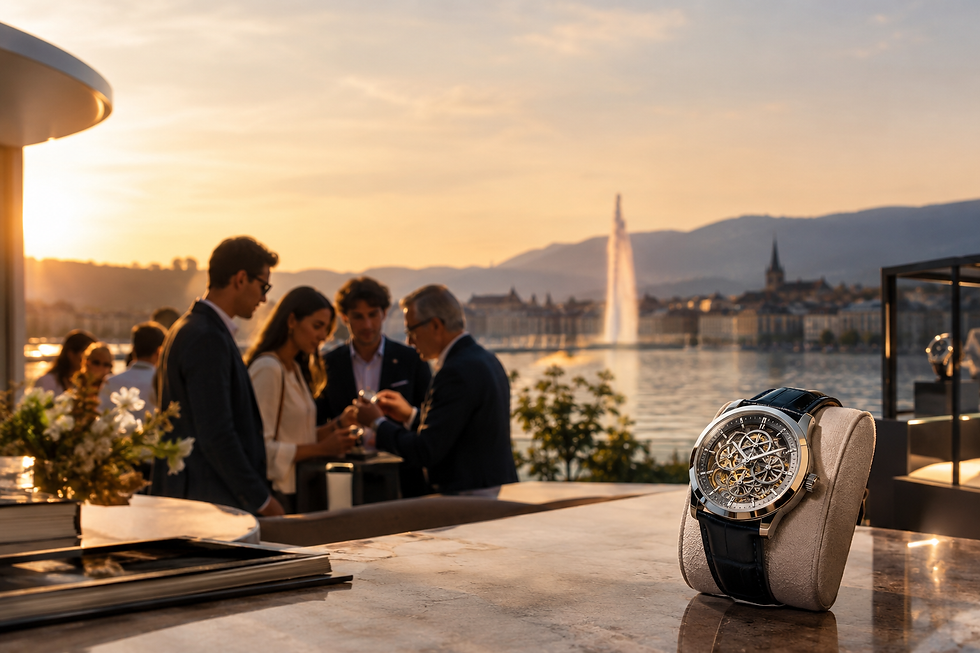
The timing could hardly be more revealing. Geneva Watch Days, held from September 2 to 6, brought together 71 independent watchmaking houses across Geneva. The event was deliberately designed as a different kind of watchmaking gathering: decentralised, open to the public and built around direct contact between maisons, collectors and enthusiasts.
What happened in Geneva therefore matters beyond the individual watches presented. It offers a glimpse into how the industry is attempting to redefine desirability.
The price problem
Luxury watches have spent years moving upwards in price.
For established brands, price increases have often been rationalised through higher production costs, technical development, precious materials, complications, exclusivity and brand positioning. But the cumulative effect is changing the relationship between consumers and mechanical watches.
Business of Fashion’s latest reporting identifies precisely this problem: the traditional model is encountering limits as brands seek younger customers whose purchasing behaviour and disposable income differ from previous generations.
The challenge is not simply that younger consumers have less money.
It is that they have different ideas about what makes an object valuable.
A mechanical watch competes today not only with another watch. It competes with experiences, technology, travel, fashion, digital culture and an increasingly sophisticated secondary market. For younger buyers, authenticity can be more important than institutional prestige; design can matter as much as heritage; and cultural relevance can determine whether a century-old name feels timeless or simply old.
Geneva’s answer: openness
Geneva Watch Days provides an instructive response.
Its 2026 edition assembled 71 independent houses and opened significant parts of the programme to the public. The official agenda included watchmaking demonstrations, collector experiences, technical competitions, discussions on desirability, the secondary market, human expertise and the transmission of knowledge. That programming is revealing.
The industry is no longer presenting watchmaking exclusively as a finished luxury product. It is presenting the knowledge behind the product as part of the experience.
One of the event’s sessions examined the question “Desirability: The Brand or the Product?” Another focused on why human expertise remains irreplaceable. There was also a discussion of the Swiss watch ecosystem from production to the secondary market.
These are not marginal subjects. They are precisely the questions the industry must answer if it wants to remain culturally relevant.
The return of the independent
The independent sector is particularly important in this transition. Geneva Watch Days is built around independent houses rather than the conventional structure of a single dominant trade fair. Its 71 participating maisons include companies whose appeal often depends on unusual design, technical experimentation, artisanal production or a highly personal relationship between creator and collector. For younger collectors, this can create a different route into horology. Instead of beginning with the hierarchy of the largest Swiss groups, a new enthusiast can discover a watch through design, a complication, a maker, a cultural reference or a community.
That shift matters because the future of mechanical watchmaking may depend less on converting every young consumer into a traditional luxury client and more on creating a new generation of people who understand why mechanical watchmaking matters.
Technology is not the enemy
The industry’s challenge is sometimes described as a conflict between mechanical heritage and digital culture. That is too simplistic.
Young consumers are perfectly capable of appreciating analogue craftsmanship while living inside a digital ecosystem.
The real question is whether watch brands can translate mechanical expertise into a contemporary cultural language without diluting it.
That means explaining movements rather than merely displaying them. It means giving access to artisans. It means making archives, complications and manufacturing processes intelligible. It means allowing collectors to understand why one object deserves a premium over another.
In other words, the next generation may not be asking watchmakers to become cheaper.
It may be asking them to become more intelligible.
That is a very different proposition.
The next chapter of Swiss watchmaking
Geneva Watch Days has therefore arrived at an important moment.
The industry does not need to abandon scarcity, craftsmanship or exclusivity. Those remain fundamental to luxury watchmaking.
But exclusivity without cultural relevance can become isolation. The most resilient maisons may ultimately be those capable of doing two things at once: preserving the extraordinary technical and artisanal standards that created Swiss watchmaking’s authority, while opening the doors sufficiently for a new generation to understand, experience and desire them.
The future of the mechanical watch may therefore depend on a paradox. The object must remain rare. The knowledge surrounding it cannot.
Patricia Holdener
Editor-In-Chief
Luxe Magazine Switzerlnad
SwissWatchmaking LuxuryWatches GenevaWatchDays
HauteHorlogerie IndependentWatchmaking WatchCollectors
LuxuryIndustry MechanicalWatches
HorologicalCulture
LuxeMagazineSwitzerland


Commentaires