Cartier High Jewellery: Inside a World Where Exceptional Gemstones Become Works of Art
Dernière mise à jour : 31 août

LE CHŒUR DES PIERRES
From extraordinary sapphires and emeralds to the enduring symbolism of the panther, Cartier’s latest High Jewellery creations reveal how exceptional stones, technical mastery and artistic vision continue to define one of luxury’s most expressive worlds.
At Cartier, High Jewellery begins with the stone. Before a design takes shape, before gold is worked and before a piece enters the workshops, there is first the encounter with a gemstone. Its colour, cut, proportions, history and symbolism all contribute to the creative process. Cartier’s approach is guided by the belief that an exceptional stone possesses its own character, capable of inspiring an entire composition. Beyond the Maison’s demanding criteria for quality and purity, the gemstone must also have a distinctive presence a quality that gives it personality and allows it to become the starting point for a new creation.
This philosophy runs through Cartier’s latest High Jewellery pieces, a collection in which exceptional sapphires, emeralds, rubellites, diamonds, spinels, rubies and coloured gemstones determine not only the visual identity of each jewel, but often its entire structure. The designer works directly with the stone, allowing its shape, colour and proportions to influence the composition. The finished piece is therefore conceived as a setting in the broadest sense: not simply a structure designed to hold a gemstone, but an artistic framework capable of revealing its brilliance, nuance and individual character.
For Cartier, this process is also the result of a close dialogue between multiple crafts. Stone experts, jewellers, lapidaries, gem-setters and polishers work alongside designers from the first sketch to the final creation. The exchange between these disciplines allows technical expertise and creative ambition to evolve together, transforming rare materials into pieces that combine architectural precision with movement, volume and lightness. As Jacqueline Karachi-Langane, Director of High Jewellery Creation, explains, the jeweller’s role is to interpret and magnify the unique character of each stone. For Alexa Abitbol, Director of the High Jewellery Workshops, exceptional craftsmanship is what brings both gemstones and creative vision to life.


Fibria: Cartier Explores the Language of Textiles
With Fibria, Cartier draws inspiration from decorative trimmings and the visual rhythm of a braid. Emeralds, turquoise and rubies form the basis of a two-strand necklace whose construction creates a striking impression of volume while preserving depth and lightness. Rubies and turquoise open the composition, bordered by diamonds, before the colour palette evolves around the clasp and along the asymmetrical strands. Emeralds complete the design, with two stones finishing the strands and three others progressively forming the central motif. The piece demonstrates Cartier’s ability to explore contrasts between materials and colours while translating the language of textiles into High Jewellery. The result is a composition in which gemstones create the impression of texture, movement and structure.


Stellara: The Power of the Central Stone
Stellara is built around what Cartier describes as its queen stone: a remarkable 41.01-carat Ceylon sapphire positioned at the centre of a highly graphic necklace. The sapphire establishes the identity of the piece, while a complex arrangement of diamonds creates a radiating composition around it. Cartier’s artisans combine openwork with diamonds of different shapes and sizes, producing a wave-like rhythm that extends throughout the necklace. One of the principal technical challenges was to preserve the precision of these radiating lines while maintaining an exceptional sense of lightness and flexibility. The structure therefore supports the composition without overwhelming it, allowing the sapphire and the movement of the diamonds to remain at the forefront.
Polydroma: When Diamonds Become Architecture
Architecture has long been an important area of stylistic exploration for Cartier, and Polydroma continues that tradition through a domed necklace entirely paved with diamonds. At its centre sits a 5.18-carat Asscher-cut diamond, surrounded by a composition built around volume, geometry and repeating patterns. Cartier transforms the diamonds into an elegant mesh whose architectural structure amplifies the visual impact of the piece. Despite the precision of its geometric vocabulary, the necklace is designed to maintain a continuous radiance, creating a surface that appears to shimmer with movement.
Panthère Tunya: Cartier’s Icon in Motion
The panther remains one of Cartier’s most powerful and recognisable symbols, and Panthère Tunya places the animal at the centre of an ambitious composition built around a 48.12-carat Zambian emerald cabochon. The two-sided gemstone possesses remarkable depth and becomes the source of a cascade of emerald beads emerging from its distinctive shape. The panther watches over the composition as Cartier gradually moves from realism towards abstraction: emerald beads appear across the feline’s onyx and diamond coat before multiplying into a flowing stream. Nine cushion-cut Fancy Yellow diamonds, totalling 10.91 carats, punctuate this river of emeralds. The composition constantly directs the eye between the animal and the cascade, creating a piece in which gemstone, movement and symbolism are inseparable.
Tipaza: The Discipline of Simplicity
Tipaza begins with two exceptional 7.36-carat briolette diamonds and a carefully matched selection of ruby beads. Together, these stones form the basis of a necklace defined by a deliberately restrained design, reflecting Cartier’s preference for clarity and precision rather than excess. Using the stringing technique, three rows of ruby beads are transformed into geometric strands alternating rubies and diamonds. The two briolette diamonds complete the composition in a waterfall arrangement descending from the shoulder. The movement of the necklace is created entirely through the relationship between gemstone cuts, lines and proportions, demonstrating how Cartier can achieve visual complexity through a reduced vocabulary.
Etnara: A Landscape Inspired by Volcanic Energy
An exceptional collection of rubellites provided the starting point for Etnara, a necklace inspired by the colours and energy associated with volcanic landscapes. At the centre is a remarkable 67-carat stone from which the entire structure of the necklace develops. The rubellites are arranged in two perfectly matched symmetrical rows and separated by topazes that introduce flashes of light into the composition. Cartier compares this arrangement to sparks emerging from a flow of lava, creating a jewel whose inspiration comes from the depth and force of the natural world while remaining governed by a highly structured and balanced design.




Tutti Chaya: Reinventing a Cartier High Jewellery Signature
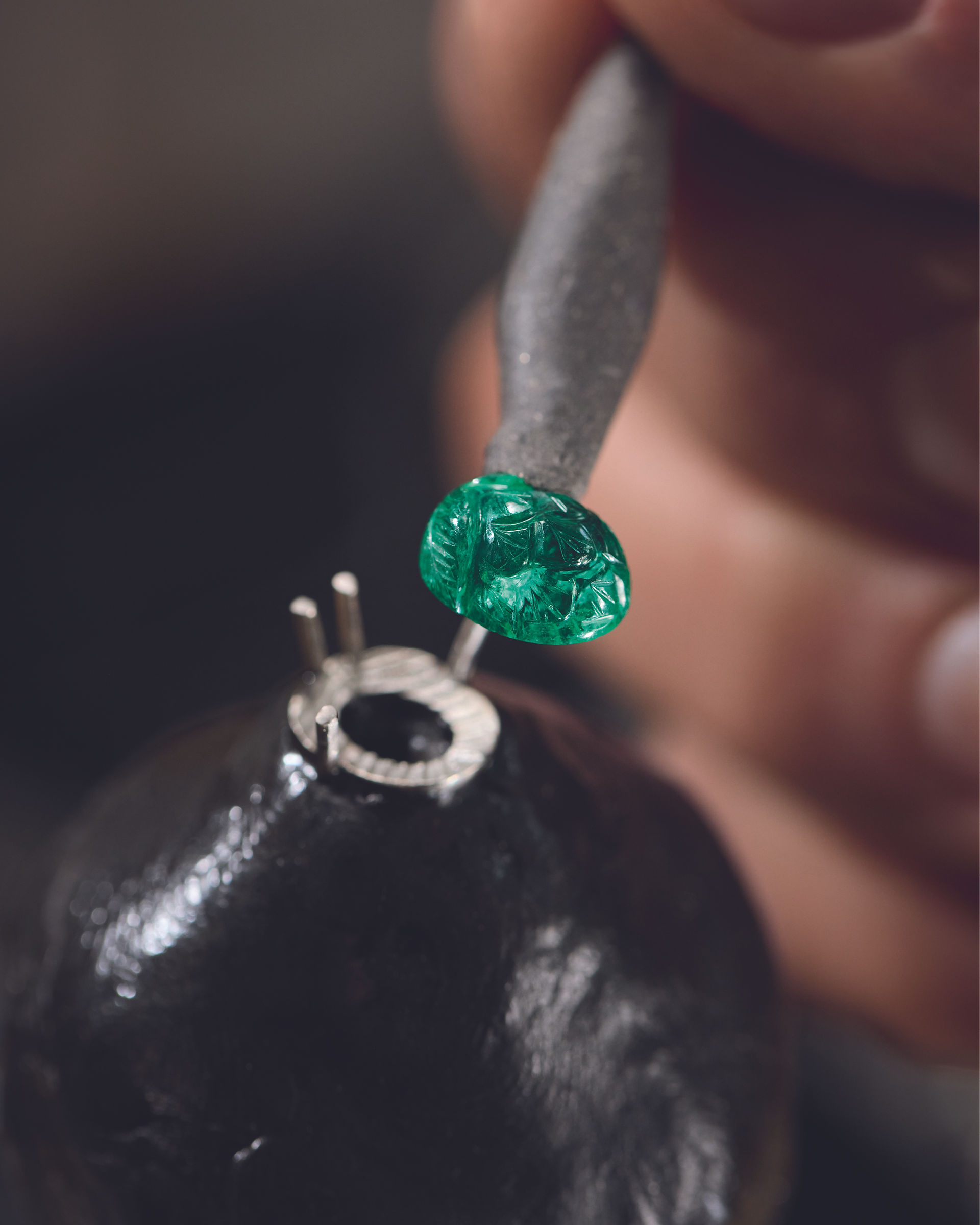
Cartier has been exploring the visual language of Tutti Frutti since the mid-1920s, and its combination of blue, red and green has become one of the defining signatures of the Maison’s High Jewellery repertoire. Tutti Chaya offers a contemporary interpretation of this tradition through a geometric mesh paved with diamonds and accented with rubies, emeralds and sapphires. Onyx adds contrast and depth, while two ribbed Colombian emeralds totalling 56.97 carats complete the asymmetrical strands and are secured by invisible clasps. A sliding clasp at the back allows the length of the necklace to be adjusted.
The technical work behind the piece is equally significant. Nearly 2,000 hours were required to create Tutti Chaya, including 1,400 hours devoted to goldsmithing, with the entire necklace crafted by hand. Cartier has also given particular attention to the reverse of the piece, transforming the bridgework between each element into a decorative motif. The construction reflects one of the Maison’s defining principles: refinement extends beyond what is immediately visible, with every part of the jewel considered as part of the overall design.
Five Earrings, Five Interpretations of Colour and Form
Cartier’s exploration of exceptional gemstones continues through five unique earring creations, each built around a distinct selection of precious stones and a different interpretation of how jewellery can interact with the shape of the ear.
Drosera began with 18 rubies totalling 28.44 carats. Their organic curves inspired a composition in which the fruit-like stones appear to be set within the cavities of a diamond-paved structure wrapping around the earlobe. Diamond droplets positioned at the top of the ear introduce the impression of dew, giving the piece a botanical and highly sculptural identity.
Ojai takes a different approach by extending the composition towards the upper part of the ear. Eighteen sapphires totalling 24.12 carats move through graduated shades of pink and orange before descending towards the earlobe. Diamond twigs hold the gemstones in place, creating a structure that appears to allow the stones to fall naturally against the skin.
Volubia is inspired by foliage and features an asymmetrical arrangement of emeralds and diamonds extending across the earlobe and upper ear. Baguette and briolette cuts introduce fluidity into the composition, creating a delicate contrast between the density of the gemstones and the apparent lightness of the design.
Patellia began with two brown diamonds totalling 11.32 carats, selected for their distinctive colour and pear shape. Cartier sets the diamonds upside down, with the pavilion facing outward and the table positioned beneath, allowing their brilliance to be interpreted in an unconventional way. Surrounded by a pattern of white and brown diamonds, the stones become the centre of a composition built around the continuous circulation of light.
Finally, Undara was inspired by the aquatic blue of a collection of spinels. The three-piece earring composition wraps around the ears in an arrangement that evokes several possible worlds: a shell, an underwater creature or waves breaking along the shore. Cartier deliberately leaves the interpretation open, using the form and colour of the gemstones to suggest an environment that remains somewhere between nature and imagination.
Why High Jewellery Is Becoming One of Luxury’s Most Important Categories
Cartier’s latest creations also arrive at a moment when jewellery is becoming increasingly important to the wider luxury market. For years, the handbag represented one of the most visible symbols of modern luxury, capable of defining trends, creating waiting lists and generating powerful cultural desirability. Jewellery, however, occupies a different relationship with time.
A jewel can accompany an individual for decades. It can commemorate a marriage, a birth, an anniversary, a professional achievement or a personal milestone. It can be worn repeatedly, collected, preserved and passed from one generation to another. This emotional longevity gives jewellery a particular position in a luxury environment where consumers are becoming more selective and increasingly attentive to craftsmanship, rarity and lasting value.
The distinction is important. Jewellery combines material value with artistic expression, heritage with contemporary design and personal symbolism with exceptional craftsmanship. It exists outside the traditional rhythm of seasonal fashion and can therefore develop a relationship with its owner that is less dependent on trends.
For maisons such as Cartier, this strength lies not only in the rarity of the materials but in the ability to transform them into recognisable creative languages. A gemstone alone does not define a High Jewellery creation. Its significance emerges through the way it is selected, interpreted, cut, positioned and ultimately integrated into a larger composition.
A New Centre of Gravity for Luxury
The growing importance of jewellery reflects a broader evolution in the luxury market. Consumers are increasingly looking beyond the immediate appeal of seasonal products and towards objects capable of retaining emotional, cultural and aesthetic significance over time. Fine Jewellery and High Jewellery answer this desire in a particularly direct way.
The latest Cartier creations illustrate precisely why. A sapphire becomes the foundation of an architectural composition. Rubellites inspire a necklace shaped by the imagery of volcanic energy. Emeralds create a cascade surrounding the Maison’s iconic panther. Diamonds are transformed into geometric structures, while rubies and coloured sapphires introduce new interpretations of movement and form.
What connects these creations is Cartier’s central philosophy: the stone remains the beginning of the story.
The Maison’s expertise lies in understanding how to reveal the individual character of each gemstone while bringing it into dialogue with craftsmanship, design and technical innovation. The finished jewel is therefore not simply a collection of exceptional materials. It is the result of a carefully orchestrated relationship between nature and human expertise.
In an increasingly competitive luxury landscape, that distinction matters. The value of High Jewellery is not limited to the rarity of its stones or the complexity of its craftsmanship. It also lies in the knowledge required to recognise potential in a material, to understand its character and to transform it without erasing what made it exceptional in the first place.
At Cartier, every creation begins with that encounter.
The stone provides the inspiration.
The Maison gives it a voice.
Patricia Holdener
Editor-In-Chief
Luxe Magazine Switzerland
LuxeMagazine LuxMagazineSwitzerland Cartier
CartierHighJewellery HighJewellery
FineJewellery LuxuryJewellery HighJewelry
HauteJoaillerie ExceptionalGemstones Gemstones JewelleryDesign
LuxuryCraftsmanship SavoirFaire JewelleryArt CartierPanther
TuttiFrutti RareGemstones LuxuryIndustry LuxuryMarket


Commentaires